Borderline Personality Disorder, Stigma, and Recovery
Borderline Personality Disorder, also known as BPD, is characterized by a pervasive pattern of instability of interpersonal relationships, self-image, and affects, and marked impulsivity, beginning by early adulthood and present in a variety of contexts.BPD is infamously known as one of, if not the most, stigmatized mental disorders. People with BPD are perceived by many as manipulative, dangerous, and untreatable. Due to this overwhelming stigma, this impacts people with BPD and ironically hinders their desire to seek recovery and be free of discrimination.
To ease the stigma and promote recovery, we ask: what are these stigmas and how are they propagated? How do they affect a person's perception of themselves? How does this affect their desire or ability to seek recovery?
About Me
My name is Asher! I'm a fourth year psychology student with research interests in trauma and abnormal psychology (personality and dissociative disorders). Research psychology is my passion and I hope to go to graduate school to work in a lab focusing on severe mental illness and functioning interventions after my bachelor's.
Blogs
Blog 1
Qualitative Research Methods for the Social Sciences
Chapter 1: Introduction

A gif of a hand patting an item from the video game MapleStory. Most people, who lack context and do not understand this gif, may see it as strange. My friends and I ascribe a certain meaning (endearance) and have an understanding of what this image is and why it exists towards the gif, hence the title of the image, while others may interpret it as weird and confusing because they are not in the same group. The different interpretations and given meanings to the same symbol is an example of symbolic interactionism.Li, Asher. April 24, 2022. "sweetheart.gif". From discordapp.com. Retrieved September 23, 2023 (https://cdn.discordapp.com/attachments/777738982355238932/967931238138675210/sweetheart.gif).
In the social sciences, people tend to favor quantitative methods over qualitative methods, although both are valid and necessary to our analysis and understanding of the natural world. To do so, we must triangulate our methods, combine several lines of sight to truly paint the most vivid picture of the world around us. We research so that we may find answers to our questions about the systematic processes that surround us. Qualitative research focuses on, most succinctly and insultingly simply described, humans just kind of being people.
Symbolic interaction encompasses many theoretical orientations, all focusing on subjective understandings and perceptions of and about people, symbols, and objects. Herbert Blumer suggested that meanings come from humans interacting and producing their own interpretations of their world, their own realities.
There are a few common tenants of symbolic interactionism: human interactions form the central source of data, participants’ perspectives and their empathy are key in formulating a theory of symbolic interaction, and how an inhabitant in a setting defines their situation determines the meaning of their actions and the setting itself. However, Blumer views humans as the ones transforming their surroundings, while Manford Kuhn argues a surrounding can trap an individual and make them predictable. Blumer advocates research being for exploration of situations followed by inspection of the data to use to refine and define concepts. opposingly, Kuhn desired to specify operational definitions of concepts that could be tested.
We search for qualitative data, considering and acknowledging one's own subjectivity and perceptions when detailing the motions individuals and their groups flow through and all of their elements.
In this chapter, a bite of structural functionalism is briefly discussed through the eyes of both Blumer and Kuhn. While they do not necessarily agree how larger social structures influence people or how people influence these structures, they both make the assertion that in some way humans must interact with the structures that they themselves have created.
Reading this chapter, I'm reminded of my Intro to Sociology class, which I now appreciate a lot more when thinking about it as a primer for some of the information in this textbook.
Berg, Bruce L. and Howard Lune. 2017. Qualitative research methods for the Social Sciences. UK: Pearson Education Limited.
Chapter 2: Designing Qualitative Research
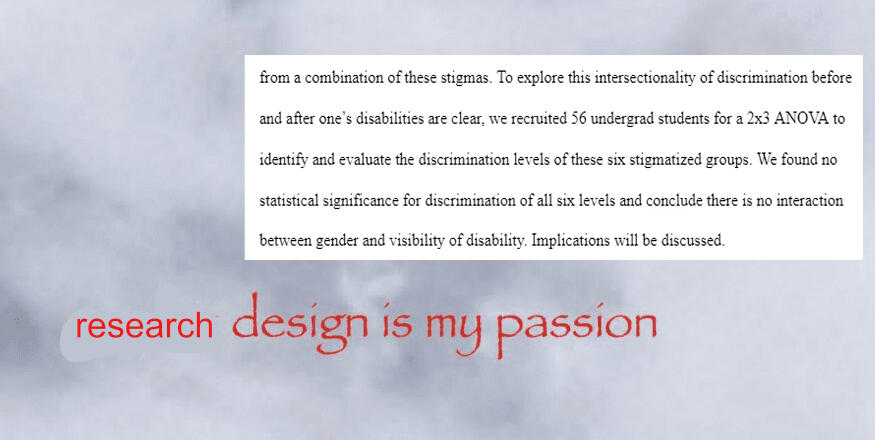
A hastily-created meme that began with a cartoon frog reading "graphic design is my passion" that I have repurposed. It includes an excerpt from my own research paper, wherein the design was so critically faulty that our p scores were dangerously close to 1. Also, this counts as symbolic interactionism because it's really funny to me because I and other people who have seen the original symbol and gain humor from it understand it but is very confusing to anyone else who doesn't.
Li, Asher. September 24, 2023. "image.png". From discordapp.com. Retrieved September 24, 2023 (https://cdn.discordapp.com/attachments/907129497428582470/1155639443252842637/image.png).
The thesis of Chapter 2 is research design. We acknowledge that there are no laws, but patterns, which social science aims to unravel. Theories make more sense of the world and require concepts, elements representing objects, properties, or features of objects, processes, or phenomenon, which communicate ideas to be understood by others. Concepts are made of a symbolic element such as a word, symbol, term, etc. with an associated and clear definition.
There exists theory-before-research and research-before theory, both models being compatible and fluid to move between. The stages involved include generating ideas, reviewing literature, refining research questions, designing the study, collecting and analyzing data, and disseminating findings.
Literature review is crucial for understanding present data. Data is now easily accessible through online material, however, websites can be sketchy and need to be validated. Keep records (recommended to be verbatim) with keywords. Use your literature review to dispel myths, explain competing conceptual frameworks, clarify the focus of your own work, and justify assumptions.
In designing research, you must consider conceptualization and operationalization to allow your variable or concept to be defined and measured. Consider concept mapping and plan for how your study will be executed. The process follows sorting and organizing your concepts and linking them together and refining your ideas. It is also critical to find the ideal location to recruit participants. They can be recruited via convenience samples, purposive samples, snowball samples, and quota samples. Sometimes, depending on question, you need to make sure you are representing the population appropriately.
Raw data needs to be analyzed, accessible, and properly used. Data must take three flows of action: reduction, display, and conclusions and verification. It needs to be coded and readily accessible, displayed analytically, and organized then able to be verifiable by others.
After everything is dissemination, allowing you to release your newfound discoveries unto the world!
Naturally, research works when the design is well-done and fails when the design is faulty. The first step is the most important.
Conceptualization can be easily viewed through a symbolic interactionism lens. Early on in the chapter, the author describes the way societies vary in their perception of animals as pets vs food. This is extendable to how many different people interpret many different symbols: to the person who lives for their religion, a religious symbol may be a comfort. Conversely, to the person with religious trauma, a threat.
Research design is something I think about frequently. The best questions to ask, the right situations to posit for the most accurate possible answers to gain the best possible data. It's a very exciting thing for me!
Berg, Bruce L. and Howard Lune. 2017. Qualitative research methods for the Social Sciences. UK: Pearson Education Limited.
Chapter 3: Ethical Issues in Research
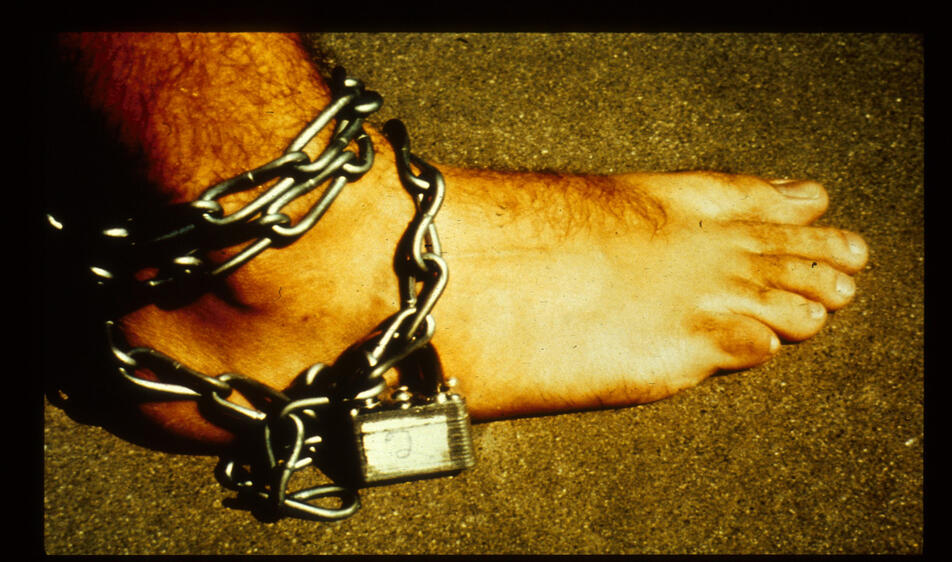
"The chain on their foot, which also is uncommon in most prisons, was used in order to remind prisoners of the oppressiveness of their environment. Even when prisoners were asleep, they could not escape the atmosphere of oppression. When a prisoner turned over, the chain would hit his other foot, waking him up and reminding him that he was still in prison, unable to escape even in his dreams."
N.d. From The Stanford Prison Experiment. Retrieved September 22, 2023 (https://www.prisonexp.org/arrival)
Social scientists abide by the mantra "do no harm".
There are two types of consent: informed consent, wherein the participant is fully aware of the study to take place, while implied consent is given by a participant when they are answering the questionnaire, implying they consent to the study. Keep in mind the potential of undersharing (not informing your participants enough) or oversharing (giving them too much information, thus potentially skewing results).
One of the most crucial parts of an study is confidentiality and anonymity. It is imperative that the identity of a researcher's participants and any identifying information are not listed in the final results. However, keeping records may pose the risk of these records being acquired by people not meant to see them. Data needs to be secured through a statement of confidentiality by each member of the research team. However, some researchers choose to violate these ethical standards by not disclosing risks and physically and psychologically damaging participants. It is therefore important to judge the cost-benefit ratio of any study.
Institutional review boards exist for this reason--existing to weigh potential harm vs potential cost. qualitative research in particular are greater struggles for IRBs due to the potential nature of association between researcher and participant. The march to create experimentation guidelines began in 1966 and eventually came to the creation of institutional review boards.
Active consent vs. passive consent coming from parents whose children are to participate in a study is controversial: passive consent is assumed if a parent does not say no, and active consent requires a parent to say yes. Passive consent may be considered unethical because a parent is not aware of the risks, but active consent may restrict potential information gathering.
In internet research, passive and active consent face their own challenges. More ethical concerns are predicated but they do not come without their benefits. research done on the internet is more anonymous, but could also be considered a loss in data such as bodily cues. Of concern as well is protection for children. It is important to prevent children from participating in your study. As always, debriefing is necessary, but another issue is the ability for participants to simply up and leave should they desire to or experience technological issues. Consider gathering the participant’s email address if the research is not anonymous, include an exit study that gives participants a way to contact the researchers if any questions or concerns come out, give participants the researcher’s own interview if some sort of issues pop up, and consider a chatroom for a real-time conversation.
The design stage is the most important part of any study for many safety and ethical reasons, to protect your participants from having their rights violated or at all harmed or having their confidentiality leaked. Human rights aside, some people simply lie and irb processes are dodged to avoid its perceived suffocating boundaries. Fraud is not difficult to commit and should be looked out for.
Mentioned previously, one worry about recruiting participants through the internet is the possibility children will attempt to participate and you must remember to not include cutesy imagery that may attract children. This is in line with symbolic interactionism: for an adult, these are simply fun and bright images, but for a child, they indicate something that is child-friendly and will possibly be attracted to. The conclusion drawn here is that children are drawn towards child-like imagery which could influence them to try and join your study.
Symbolic interactionism is applicable to the worry of child-like imagery possibly used to attract children. To the adult, cutesy imagery can be brushed off because they do not ascribe much meaning to these symbols. To the child, it is something that can attract or influence them, which researchers should be aware of.For my research, it is important to consider ethics and keep in mind recruiting participants on the internet, as that is virtually my only option. The vulnerability of my population and recruitment process are my top concerns.
Berg, Bruce L. and Howard Lune. 2017. Qualitative research methods for the Social Sciences. UK: Pearson Education Limited.
Chapter 4: A Dramaturgical Look at Interviewing

Two people engaged in an interview, with theater masks influencing what both interviewer and interviewee are saying. Edited by myself.
BRO Vector. March 10, 2020. Candidate and HR manager having job interview stock illustration" From iStock logo. Retrieved September 23, 2023. https://www.istockphoto.com/vector/job-candidate-and-hr-manager-meeting-for-interview-gm1211288835-351213484.
What is an interview? Done only by someone with natural talent? An art rather than a skill or science? A game with two participants? Or a learned skill as one may learn to ride a bike?
Consider an interview a performance; the researcher is an actor, putting on a show in how you hold yourself and communicate with participants. You’re cast in the role of a listener, an expert, a writer, a gatherer of information given to you by your participant who holds it.
Research can be split into data collection and data analysis. After getting in, various ways in which to enter a setting, comes data gathering, followed by analysis and turning your information into data.
The social performance, also simply known as a performance, is similar to the dramaturgical model of interviewing, which is in turn like active interviewing.
The social performance (simply a performance) is more immediate than the traditional interview. The active interview values the circumstance created, and the dramaturgical model uses the constructed relationship to elicit information from a respondent. All of these acknowledge that an interview does not consist of just information gathering but is a relationship between the researcher and their inquiries and their participants and their thoughts.
Naturally, interviews come with flaws and suit some purposes but not others. Most important to note is that interviews are flawed in many ways: by the nature of participants not knowing things they don’t know, the unreliability of memory, and the ability of a participant to only give one perspective. They are good at providing a piece of a person’s brain, their preferences, their thought processes, their intentions, but they are not so good at discussing events, behaviors, or deeper motivations.
There are several types of interviews: the standardized (formal or highly structured) interview, the unstandardized (informal or nondirective), and the semi-standardized (guided-semistructured or focused).
The standardized interview follows a “schedule” of interview questions, all asked by the researcher in exactly the same way in an attempt to produce somewhat comparable responses. These questions are assumed to be comprehensive and simple enough to gain all relevant information to the study and are clear and understood the same by all participants. These are good for gaining tangible information and for multiple interviewers in different settings for easier data aggregation.
The unstandardized interview is a stark contrast to the standardized, wherein researchers do not follow stringent, inflexible questions but more akin to general guidelines about the topics at hand. The assumptions made are not all necessary questions are already known, so it would be impossible to produce a comprehensive list, and participants will not interpret the questions in identical ways. These interviews sound like conversations, and participants have more control over the situation than the researcher. Interviewers have to come up with questions adaptively and create new ones for new situations and probe for unexpected information. These types of interviews are best utilized expecting the unexpected.
Finally, the semistandardized interview falls somewhere between these two. Predetermined questions exist, but it is encouraged for researchers to continue a line of questioning should the opportunity arise. These questions, too, must have familiar wording but this time seek to approach the world through the participant’s eyes. Consider the factors that go into deciding what kind of interview you would like to do for your research: the nature of your research, what kinds of questions you want to ask, and what kind of answers you’re hoping to obtain from these questions. All of these things ultimately lead you into how you develop your interview guidelines.
Developing interview guidelines comes in several parts. It begins with brainstorming what, broadly, subjects you will be relevant to your research. This is refined as you review literature. This outline itself has narrowed down depending on what kind of interview you would like to conduct which will influence how precise the structure of your interview will be. Next is sequencing of questions and their content and style. Mentioned previously, consider the backgrounds of your participants to ensure that they will understand the questions asked and tailor them to the situation. In regards to sensitive information, it is best to begin with easier questions before diving into more sensitive topics to ease participants into volunteering information. However, this can also seem manipulative. The lead-up should not last too long so participants know what they’re getting into, but there is always a chance participants may feel threatened by the switch in topics. Transitions between topics should be clear and specify what the next topic of conversation will be.
No matter the interview, there are a few types of questions that are asked. Essential questions are about the central feature of the study aimed to acquire specific information. Extra questions are questions similar to essential questions but worded differently to test for reliability of responses. Throwaway questions can be used for a variety of purposes. They may be used to establish rapport, set an interviewing pace, draw out other bits of crucial information, or relax the participant if they begin to become agitated or defensive from your current line of questioning. Probing questions aim to have a subject elaborate on a current topic to gain more information about it.
One thing to keep in mind about questions, no matter what type they are, is how they are worded and ensure that they are not too clinical and uncomfortable for the participant and can be understood by all participants. While this may involve “dumbing down”, this may make others feel as though their intelligence is being insulted. Interviewers must keep in mind that there may be certain slang developed by the groups they are interviewing.
There are a few issues with research questions. Three of these are affectively worded questions, which may come off hostile and produce negative responses, double-barreled questions that are essentially two questions in one, making it virtually impossible for respondents to give a proper answer because you may not be sure what question they’re answering, and complex questions wherein some parts are accidentally disregarded in favor of other parts because of how convoluted the question is.
Another factor in interviewing is the length. Again, your research guides not only your form of interview, questions, but also the length of the interview, with more complex research questions requiring perhaps over a hundred questions. For example, a life history may be very long and even span days, as would interactive or interpretive orientations that require the researcher and participant to develop a relationship. And naturally, a longer interview will take longer, which makes interviewers worried their participant may get bored with the conversation. However, should a conversation be engaging, both the interviewer and interviewee may be excited to participate in the exchange. Budgeting should be considered in crafting the length of an interview. Part of this budget may also be used for bribery if you so choose.
Telephone interviews may also be a great option depending on roadblocks such as geographical distance. These are best used when a researcher has more specific questions in mind or there is an established relationship between researcher and participant. Telephone interviews have the advantage of reaching large areas, requiring less staff, allowing the interview to be monitored and with audio, easy to transcribe, provide a reassuring anonymity to participants, and they are relatively inexpensive. However, some groups simply may not have telephones or public numbers or even pick up when called by strangers, which excludes potential interviewees, and do not capture the full picture of a participant’s actions when being interviewed.
In web and email-based interviews, they can either occur synchronously, allowing the researcher and respondent to talk in real-time over the internet and also gives researchers the freedom to probe as in face-to-face interviews, even with cameras if desired, or asynchronously, through emails or forums, which are commonly used with survey-based research. However, asynchronous email interviews may lack real-time responses, but at the same time, do not restrict the interview to a block in a schedule that works for both researcher and participant. These email interviews are also more or less private, barring hackers or misplacement of data. On the other hand, disadvantages include the loss of visual cues, ability to spontaneously probe, and participants are limited to literate computer users.
Qualitative interviews are not natural ways of communicating. While they may seem like it, the researcher will observe another party more intensely than normal, accounting for a participant’s misdirection, which can be handled with the dramaturgical interview. Most importantly is the interviewer’s role and the roles that they may perform. Overall appearance and the way an interviewee carries themselves have a great effect on how they are perceived. In some cases, there are preexisting biases that can affect the results of a study. To the interviewee, the interviewer has flexibility in how their role-taking is performed and allows them to be who they need to be. This is important so that interviewees are more willing to open up, but there still may be bias regardless of how an interviewer looks and their manner. In the same way, an interviewee wants to manage their impression on the researcher, presenting themselves in the best possible way anxiously. To manage this, an interviewer needs to be a more self-conscious performer during the interview by preparing actions, lines, roles, and routines beforehand.
The dramaturgical interview is made for fluidity and takes into mind rapport, without disregarding boundaries and is not a conversation built on equality. Rapport still needs to be established, which can be done by establishing common ground, or understanding that you do not share common ground but rather develop the appropriate relation to the interviewee. Despite having some sort of relation, the interviewer, by nature of what an interview (especially dramaturgical) is, is always in control of the situation.
“Intuition” is a misnomer for how interviewers can react in situations. More accurately, social interpretations are how an interviewer manages social cues. Nonverbal ways of communicating combined with their speech is known as full-channel communication. Social interpretations are on the spot and exchanged by both interviewer and interviewee and are part of a conscious social performance, aware of and responding to interactions that may be unconscious, but not necessarily unintended. This is necessary to manage the interview process and avoid making mistakes that would hinder an interview but even draw out more information. But interpretation of body language is not data collected.
“Intuition” or rather, the way sociologists analyze and react to behavior, can be framed in a symbolic interactionist lens. In this frame of symbolic interactionism, social cues serve as symbols that convey information and meaning.
It is vital that you prepare for an interview at least with basic questions. There are many situations to develop rapport, such as by chatting to establish rapport before the interview has begun and allow the participant to manage their impression. It is often assumed participants will not open up about certain topics, but when they do, they will to a surprising degree, although some do refuse outright. Establish that what they have to say is important and will be listened to and do not underestimate the time the interview will take to maintain trust.
Your first interview can be known by many ways, but are your first attempts. These can be with more experienced interviews and once you are one yourself, you can draw on your own experiences. There are various strategies you can use when getting started. Uncomfortable pauses may seem, y’know, uncomfortable, but give the interviewee to pause and fill the air. Echoing is saying things that a participant has said or reassurances that you are listening and hearing them. Most importantly, you must let people talk!
There are a handful of tenants to keep in mind when interviewing. Develop rapport, keep on track, be as relaxed and natural as possible, demonstrate interest, think about appearance, interview in a comfortable place, don’t settle for monosyllabic responses, be respectful (especially of culture and audience), practice, and be cordial.
Analyzing data analysis is abstract. You can analyze through content analysis, but reduce items from qualitative data and ignore more meaning. Consider ordering and organizing your data. This is finding systematic patterns between two or more researchers or coders to increase inter-rater reliability, listing major topics and subtopics underneath them to create index sheets that contain codes that identify the transcript it came from. This can be time-consuming, but makes the process easier later. You can create a quick response sheet to reduce replies to short responses for convenience. After index sheets are properly annotating, there is now a comprehensive means for accessing information to analyze various specific themes and reduce mass of textual information for analyzable data. You begin by identifying key concepts and examples from each and find the most generalizable pattern from the topic you are looking for. Your final code categories will be expected ones and those discovered in analysis.
Sometimes things work and sometimes they don’t. Many people will be willing to help you understand them and tell you what you need to know, but some people won’t. Even if they do, everyone has faulty memories and different interpretations and explanations of their experiences which makes it difficult to compile this data.
The chapter talks about "intuition", which is really just a researcher's reception and interpretation of nonverbal cues such as body language, facial expressions, or utterances. These are all symbols that are interpreted by the researcher and both interviewer and interviewee exchange these symbols throughout their interactions.
Quite frankly, this chapter stressed me out because it was so incredibly full of content I felt I was unable to shorten without losing critical parts but I am trying really hard to change that. But all in all, it wasn't a particular complex or confusing chapter because I've heard most of these things before in my Experimental Lab and Intro to Research classes, but it's never a bad thing to have a refresher even if it did take me like four days to read.Berg, Bruce L. and Howard Lune. 2017. Qualitative research methods for the Social Sciences. UK: Pearson Education Limited.
Visual Research Methods
Chapter 2: Observing Culture and Social Life
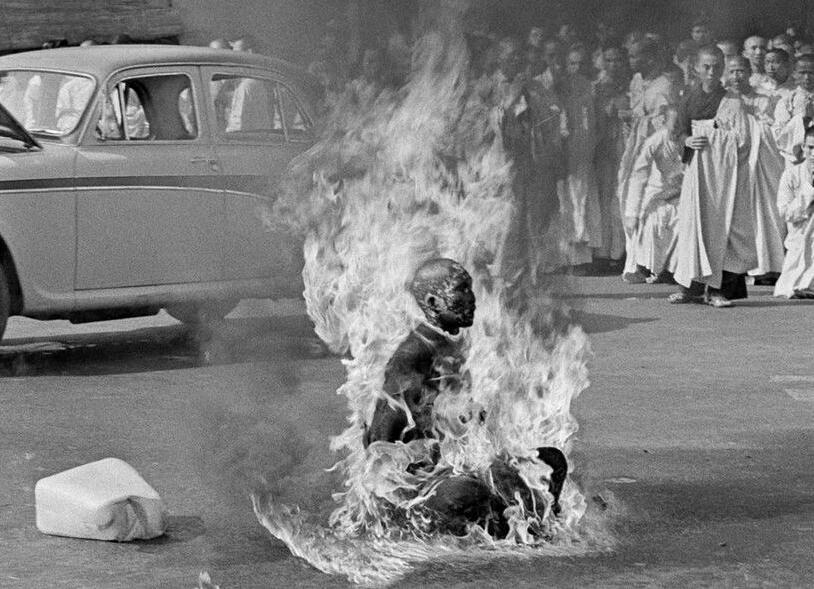
Thích Quảng Đức, Vietnamese Mahayana Buddhist monk, commits suicide via self-immolation protesting against the persecution of Buddhists by the US-backed South Vietnamese government of Ngô Đình Diệm, a staunch Roman Catholic.
Browne, Malcolm. June 11, 1963. From The Associated Press. Retrieved September 23, 2023 https://upload.wikimedia.org/wikipedia/commons/0/0f/Self-immolationofThichQuangDuc.jpg.
there are valuable lessons to be gained from the examination of epistemology and methodology, benefiting different types of researchers and social scientists alike. It sheds light on implicit choices made by social documentary photographers in documenting culture and social life and prompts questions about choices made by social researchers, some of which may go unnoticed.
Becker and Collier talk about photographic processes that implicate the relationship between epistemology and methodology. There are several ways of thinking about this relationship, such as interpreting methodological strategies having a mirror relationship with epistemological principles. It can also be arbitrary, with many and differing approaches that are closer to social circumstance than knowledgeable rigor. A third way is that they are loosely coupled, wherein there are some useful inquiries and some supporting logics of inquiry.
Wagner posits that social documentary photography and social science fieldwork are defined by contrasting social practices. He defines empirical social inquiry as an effort to generate new knowledge of social life through real-world evidence and data. Contrary to popular belief, studies aren't always quantitative, and pictures aren't likely to be as empirical as expected.
Sense data can be “real” but are subject to distortions of perceptions and memories. Photos or videos may provide unique evidence but also judgments that are not always factual. They may be manipulated but also provide evidence on how people want to be seen by others. Artifacts can also be useful but manipulated. Page layouts can create false impressions, but highlight details. The desperate search for empirical data ironically limits what can be acquired in forms of things like documentary photography. Research design also boasts false claims of empiricism. Personal accounts can establish credibility and are used frequently by documentary image makers. However, these can complement each other as much as they need to be attended to when investigated. But these choices, made by both social researchers and documentary images, both strive for empiricism.
Different documentary makers have their own philosophies in taking pictures, but their personal accounts open a window to different ways of thinking about empiricism in visuals. Wright Morris argues that there is only fiction and “the facts of life” will reflect the intents of investigators and reporters, whether in photography, writing, research, and analysis. These can all diverge from “things as they are” more or less depending on the investigators. Clifford characterized “ethnography as fiction”, which is not always false. Inventions exist for the researcher and knowledge and do not substitute but rather guise observation and analysis. Many also say that the personal vision of social researchers can contribute to empirically sound accounts. But for this, experienced field researchers need to change their line of questioning and reframe their views in certain settings and depend on their ethics. Most scientists and documentary photographers introduced want to come as close as possible to “reality”.
A few projects are analyzed. Material World: A Global Family Portrait (Menzel, 1994) shows attempts for the impact to be empirically credible and display incredible skill on behalf of the photographers, but who's to say these images represented what they were meant to? Did we learn anything? Was it of enough empirical soundness to challenge speculation and ignorance?
Girl Culture (Greenfield, 2002) wants to get it right as well. She illustrates the exhibitionist inherent to the feminine identity due to public female appearance and the self-loathing the inability to fit into these female appearances causes. Greenfield makes commentary on girl culture, giving it a level of empiricism and complexity.
The Great Central Valley: California’s Heartland (Johnson, Dawson, & Haslam, 1993) brings together many materials as evidence of changing life and culture in the central valley of California. In supplemental commentary, Johnson talks about the editing of old photographs for clarity’s sake.
All three authors provide information unable to be found anywhere outside of the photographs. These also differ from the typical social science study because they’re very personal and situational. These studies don’t utilize an explicit research design but add additional context for data. The imagery is also supplemented by other, more traditional forms of data, that highlight empirical validity in their work. They enmesh visuals and aesthetics with design, acknowledging issues like social researchers. They provide more, and “new knowledge” with their expanded reach due to the ability to present their work more widely. But they do not fit into the mold of social science journals, but also largely do not intend to, and challenges social theory in presenting their work of images and data and in so many other forms. There are many advantages, some of which are the best ones to take advantage of under many circumstances, especially for human service professionals and other people whose knowledge doesn’t need to be built on social scientific approaches. These observational studies are critical to adding new information that text and data alone simply cannot provide.
The easiest way to analyze this is through a symbolic interactionist lens. Photographs are one of the most obvious examples of symbols and as described many times before, these symbols change based on who sees them and what they gain from them. In the example image, there are many people who do not understand the context, greater meaning, or care to see it at all. In others, it triggers a deep sense of emotion.
This chapter was interesting because of the way it explains the benefits of both integrating photography into data, which is something I've never personally considered. I think adding a visual element outside of tables and charts would be a good, albeit not socially acceptable in the greater scientific community, addition to research papers to increase the scope of understanding.
Wagner, Jon. 2007. "Observing Culture and Social Life" Pp. 23-57 in Visual Research Methods, edited by G.C. Stanczak, Thousand Oaks, CA: Sage Publications, Inc.
Chapter 3: All Photos Lie

A couple posts two pictures on Twitter.com, both with him and his girlfriend, but in both pictures one or the other is blocking their eyes from the sun. Another user offers an edited version where neither are shielding their eyes. An example of spacial and temporal editing (but kind nonetheless).
@TheCrosshair. 2021. "hey man let me know if you want me to delete this but i edited a version where you're both in the sun" From Twitter. Retrieved 23 September, 2023. (https://twitter.com/The_Crosshair/status/1364964746718568458)
A refreshingly short chapter, All Photos Lie describes the reasons and ways in which photos lie. There is no truly honest image that will represent the whole of reality because of the types of manipulation that go into producing a photo. The process of taking a picture is where the manipulation begins: the choice of lighting, what equipment is used, the scenery, when the picture is taken, why it is taken, and who influences the photo. All of these things contribute to a photo that, no matter what, is always affected in some way by the photographer, even if they put their all into trying to be as objective as possible.
Afterwards, photos may be edited in a number of ways. They can be cropped to focus on a certain feature a photographer wants to highlight, the lighting and contrast manipulated post-photograph, and even temporal or spatial editing, which is a changing of when a picture was taken or overlaying multiple pictures together to create an entirely new one.
No matter how a photograph is created, it simply will not catch up the complexity of the human eye. Cameras and eyes perceive things very differently and it's impossible to capture on the camera what people see with their own two eyes in field of view, color and light perception, etc.
Even if no editing takes place and care is taken for a photographer to not capture a moment on purpose or with specific intention, it will always only be a snapshot of reality. One image can only ever represent a fraction of a second of what is real.
Photographs are symbols; it is possibly the best way to describe them. We as individuals will have our own interpretations of different images, alleged reflections of reality. This photograph becomes a symbol of our reality, and through photograph manipulation, the photographer gets to choose what reality they present to the viewer.
I've always liked taking pictures, and I had a brief stint where photography consumed me whole. I took a lot of pictures of flowers and it took a lot of time and effort because I was always waiting for the clouds to pass for just the right amount of lighting, choosing which flowers I wanted to take pictures of depending on how good they looked. When I got home, my dad and I would pick the best ones and work together to adjust the lighting and contrast to make the pictures as beautiful as we wanted them to be, even if that isn't what they looked like when I saw them with my eyes (which do not, believe it or not, do not change the white balance of things I see at will). Even so, because it was from nature, I felt like it was natural. It's an interesting reframing of everything I knew about photography: that I was always manipulating what was in the viewfinder.
Goldstein, Barry M. 2007. "All Photos Lie" Pp. 61-80 in Visual Research Methods, edited by G.C. Stanczak, Thousand Oaks, CA: Sage Publications, Inc.
Blogs
Blog 2
Qualitative Research Methods for the Social Sciences
Chapter 5: Focus Group Interviewing

A virtual focus group, which I will likely be doing.September 21, 2021. "remote-work-communication.jpg". From Chief Learning Officer. Retrieved October 13, 2023 (https://www.chieflearningofficer.com/wp-content/uploads/2021/09/remote-work-communication-scaled-1-768x422.jpg).
Focus groups are small groups discussing specific topics led by a moderator, collecting data not only on the topic but also on the interaction between members. They generally require eight elements: a clearly defined objective and/or research problem, group characteristics, a comfortable atmosphere, and rapport. Additionally, they need an aware listening facilitator, a well-organized facilitator, structure and direction, but restrained contributions to the discussion, research assistance, and systematic analysis. Extended focus groups include a questionnaire for participants before a focus group session, allowing them to orient themselves before the discussion begins and enabling the moderator to balance opinions.Data collection starts with a well-prepared moderator's guide, which contains an introduction and introductory activities to help members acclimate to each other and the topic, a statement of basic rules or guidelines for the interview, short question-and-answer discussions to spark conversation, special activities or exercises, and guidance for addressing sensitive issues that must be discussed beforehand.Focus groups can uniquely capture participants' desires to explore and defend their opinions and beliefs, which are often communicated through participants' interactions and nonverbal expressions. Transcripts of the discussion should be taken and their contents analyzed for trends or patterns. They should also be indexed and coded. The analysis should also pay attention to consensus (points of agreement within the group), dissensus (points of contention within the group), and resonance (points the group can relate to). It's important to remember that in focus group data, quantifying results should be avoided. Instead, provide quotations to support the assessment of trends, offer relevant characteristics of the person being quoted, and make a point before using quotes to demonstrate it.There are many ways to use focus groups. They can be used to pilot an interview schedule and gauge how comprehensible questions are to multiple people. They are also valuable for primary data collection on difficult subjects and can provide a supportive experience for participants. When selecting participants, consider identifiable factors that might shape a subject's participation, and when these factors need to be held constant.Recently, virtual focus groups have emerged, which can be conducted in a live setting or asynchronously through email or messaging services. These virtual groups lack the traditional focus group's characteristic group dynamic but allow participants to think through their answers without interruptions, especially in time-extended focus groups, such as in forums. Virtual groups can be useful for reducing costs, reaching a wider geographic area, and reaching participants who are hard to access. However, these groups may lead to a loss of the moderator's role and the sense of atmosphere and participant attention traditionally associated with focus groups. When searching for focus groups, consider gaining specific access to a study population, such as in time-limited circumstances or where participants of interest congregate.Like other forms of data collection, there are many mistakes that can be made in focus groups. It is possible to be too vague, use too few groups, which can limit the sample size, overload interview topics and exceed the allotted time. This may require a moderator to cut discussions short to fit the schedule or result in overly large groups. Balancing the influence of participants is crucial. Some participants may dominate the discussion while others may not have enough influence, affecting the quality of data.Lastly, ensuring confidentiality is paramount. While maintaining confidentiality between the researcher and participant is relatively straightforward, ensuring that sensitive content does not leave other participants can be more challenging. If participants are aware of this risk, it may lead some to drop out.Focus groups ultimately succeed when participants get along and genuinely engage in discussions. However, the inherent unpredictability of human behavior is beyond a researcher's control, and participants may occasionally disagree or provide tepid answers to maintain peace, thus limiting the depth of the discussion and data gathering.In symbolic interactionism, focus groups come together to exchange symbolic meanings and are a space where participants can discuss topics and engage in the symbolic exchange of ideas and perspectives which reflect how they interpret the world around them.From a sociological imagination perspective, we can see that the elements required for a focus group can be interpreted as products of larger social structures that influence research practices, such as educational institutions that produce things like this textbook.I will be using focus groups in my research and I am equal parts excited and nervous!Berg, Bruce L. and Howard Lune. 2017. Qualitative research methods for the Social Sciences. UK: Pearson Education Limited.
Chapter 6: Ethnographic Field Studies
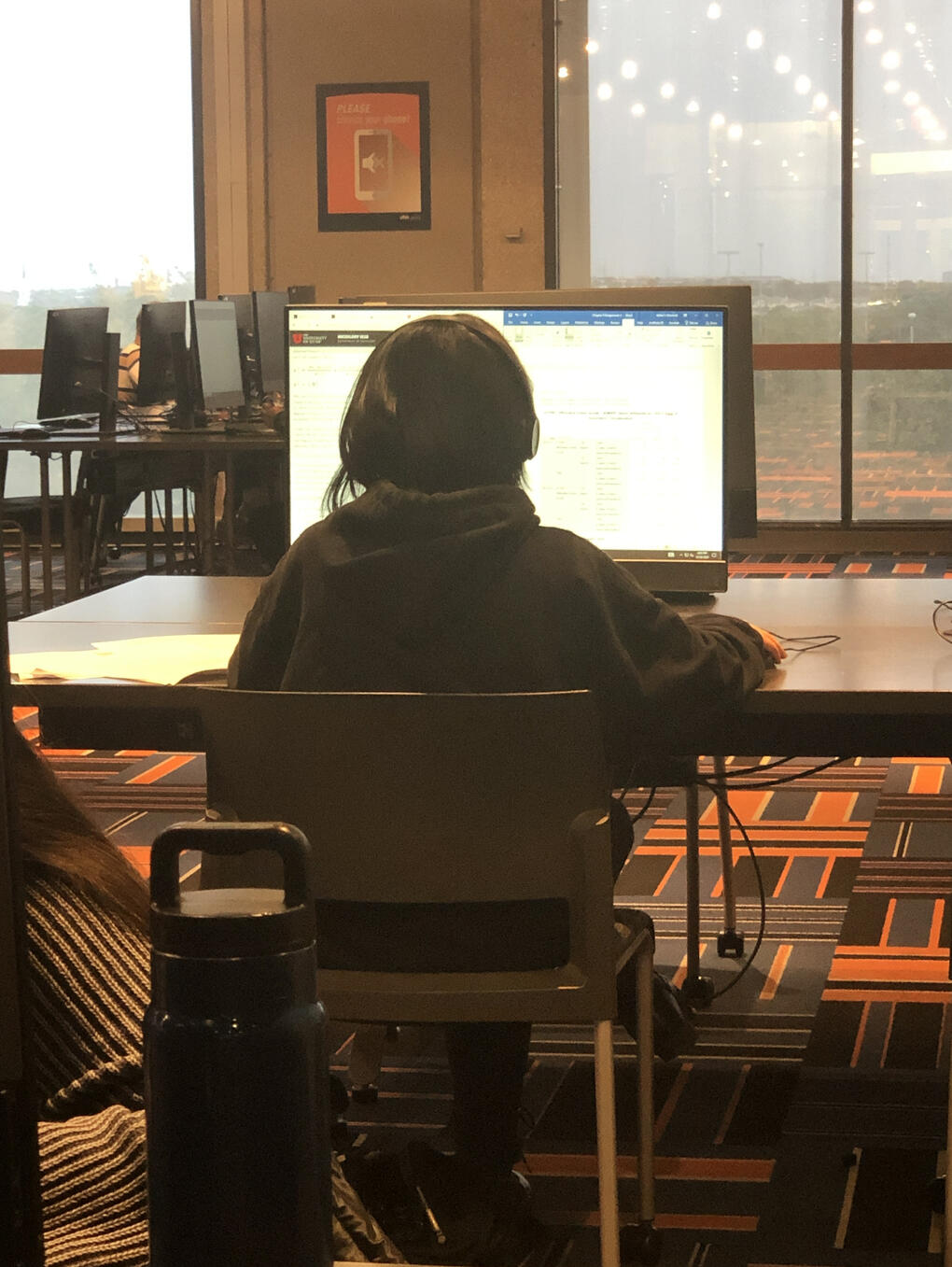
A picture taken of myself by a friend without my knowledge, doing homework in my natural habitat (the library quiet computing area).Powell, Richard. October 30, 2023. "IMG_3765.JPG". From discordapp.com. Retrieved October 30, 2023 (https://cdn.discordapp.com/attachments/1078056291349569637/1168685375439519814/IMG_3765.JPG).
Ethnography is defined as the study of culture, but its meaning and usage have evolved over time. Some define it as the work of describing a culture or understanding another way of life from the native point of view. The first phase of ethnography is 'getting in,' which can be covert or overt and affects research, laying down its foundation. While covert research may be necessary in some cases, it can also raise ethical concerns, such as voluntary consent and the potential harm to participants, necessitating the maintenance of privacy and the rights of participants. Gaining entry can be difficult and should always start with gathering information. You may also bargain with participants to gain entry, but this may be risky. Bargaining may take place with gatekeepers who can grant or deny access to research settings. Consider finding a guide or informant to help you navigate your situation and vouch for you. Overall, a larger network means greater access and the ability for further cooperation.Becoming an invisible researcher may be necessary to escape the Hawthorne effect and researcher reactivity by blending into your surroundings. However, there are several risks to becoming invisible. Misrepresenting themselves intentionally, a researcher's role could be taken as real. Accidental misidentification could lead to researchers being found guilty by association with the group they are with. This can lead to learning more than you want to know, such as planned criminal activities. While researchers often protect their participants well, using things like certificates of confidentiality, contemporary ethnographers who work in settings fraught with violent conflict and other risks are potentially at risk, either ambient or situational. Ambient dangers can be avoided, while situational danger is triggered by the researcher themselves. Take basic safety precautions and know insiders who would vouch for you.Much of ethnographic research is about observing a setting and listening, determining what it is you want to know and looking for those things and letting them guide your study. Take in your physical setting to think about how to cover areas efficiently, get acquainted with inhabitants, and draw first impressions for points of reference. Find guides and develop relationships and establish rapport, which may allow you to snowball relationships. After establishing relationships, it is now possible to track, follow, and observe people (without barging into conversations). During this, you may be able to identify central figures, known as stars, who can act as gatekeepers due to their influence.Ethnographic accounts come from field notes that include verbal exchanges, practices of participants, and connections between observed actions, interactions, and behaviors. Field notes can be taken in a variety of ways, but generally start off brief and are elaborated on later. The author starts with cryptic jottings that are meant to trigger memories later, followed by detailed descriptions after exiting the field, analytic notes or observer comments that come to you while writing field notes, and subjective reflections on your experiences, all timestamped. While, naturally, memories degrade over time, there are many ways researchers recall data. These can be recording key words and phrases while in the field, making notes about the sequence of events, limiting time remaining in the setting, writing full notes immediately after exiting the field, and writing notes before sharing them with others. After field sessions, there are often an overwhelming number of field notes which can be reduced for ease of comprehension and use using computers, but qualitative data should not be reduced so much that you begin to lose data. Ethnography can now be carried out online, through multiplayer games, blogs, forums, and social media. This is cheaper, easier, and more accessible but loses some data in the process.Analyzing ethnographic data begins by reading field notes to reinforce hypotheses or themes developed during data collection and generate new ones to apply to the data through open coding, which allows researchers to identify and extract themes, topics, or issues systematically and by coding, systematically create records of patterns in conversations and activities of people in field notes. To document themes and patterns in the data, researchers must choose comprehensive content analysis or rely on textual accounts to document themes and patterns easily observable in the data.Typologies, sociograms, and metaphors are different methods of interpretation and analysis. Typology classifies similar events, actions, objects, people, or places into discrete groupings and identifies various distinctions, which can be done textually or visually through photographs. This is done by assessing collected material and seeking out mutually exclusive categories, followed by making sure all elements have been exhaustively categorized, then examining the categories and making meaningful appraisals. Sociograms are part of sociometry and allow researchers to gauge the degrees of affinity group members have regarding one another, allowing you to consider friendship patterns, social networks, relationships, and social distance. Sociograms are a graphic display of how close people are to one another based on responses to a sociometric test. These tests usually include a specific number of choices that vary with the size of the group, a specific number of choices allowed varying according to the functions and/or activities of the group, and the level of preferences assigned to each choice. Early sociometric tests employed a peer nomination version, wherein members named three or more peers they liked, and each member's scores were computed. This was adapted into negative peer nominations, which asked not only about positive peer nominations but what peers members disliked the most, which identified the popular group and the rejected group. Peer rating procedures were then added, using a Likert-style scale to rate other members. You can use this sociometric choice test data to provide another line of action for a triangulated research design or use sociograms after analyzing fieldwork observations to measure your examinations of group dynamics to how the members themselves feel. You can create sociograms in the field using direct observations of body language, person and object placement, mapping locations, during which you can identify stars and satellite cliques that form groups. Metaphors can be used to reflect on data but are used less scientifically than they are literary.The final part of ethnographic field research is getting out. If handled improperly, it can distress a research community or jeopardize future research relations. How getting out is dealt with depends on the research, where sometimes a strong emotional bond is formed between the researcher and the participant, and additional care needs to be taken.Reflexivity is the researcher's awareness of their own role in the research process and recognizing that ethnography is about understanding more than observing. It actively constructs interpretations of experiences in the field and questions how those interpretations arose. Similarly, critical ethnography is an angle where a researcher has a concern about societal inequalities and moves for positive change through advocacy, seeking to empower participants by challenging the status quo. Critical and conventional ethnography are comparable but differ in that conventional ethnography is 'what is,' while critical ethnography is 'what could be.'The researcher's attitude is a critical part of a study. You must go in with an appreciative and empathetic mindset. Value neutrality has its place in critical ethnography and calls for a distinction between attitude and values. However, value-neutral positions are not possible in science because of biases and perspectives all people, including researchers, hold, and masquerading value neutrality prevents readers from understanding the truthfulness in the researcher and study results. When presenting subjective disclosures, the reader is provided insights into the world of research and orients the reader to the researcher's perspective and articulates the interests or biases of the researcher.Ethnography is fun and brings new perspectives, but random chance can leave data lacking, and an unreliable guide may skew your data gathering, if you even gain a guide at all. In the end, it's also a long process, but the data can ultimately be worth it.Ethnography is something I've done previously for my Intro to Research Methods class, and once again what I have done here. The location I chose for my field studies was the quiet study area of the library, where I frequent to do schoolwork. I took notes on three separate occasions and made a handful of interesting observations.1. Every single time I'm there I sit in the same spot, as does the guy who sits at the table next to mine. He's there every single time I am and is singlemindedly focused on his work for the duration of his stay, which is almost always longer than mine.
2. Being in the study area has made me startlingly cognizant of the fact college is designed to educate students in specific fields of study which may sound like a stupid observation to make, but you never really register it until you see people studying very distinct and different things. I've seen a lot of science and engineering majors getting work done, and was particularly jarred by some guy looking at the periodic table, which I myself have not done since my sophomore year of high school and made me realize that some people study chemistry on purpose. I saw a guy look at sheet music on his laptop for like five minutes and then leave.
3. Some people eat meals, implying they spend a good portion of their days in the quiet study area.
4. A lot of people are really bold and leave their valuables sitting unattended for up to an hour. I'm not saying that I want to steal that one guy's open, unlocked laptop and his keys, I'm just saying it would be dangerously easy to.Berg, Bruce L. and Howard Lune. 2017. Qualitative research methods for the Social Sciences. UK: Pearson Education Limited.
Chapter 7: Participatory Action Research
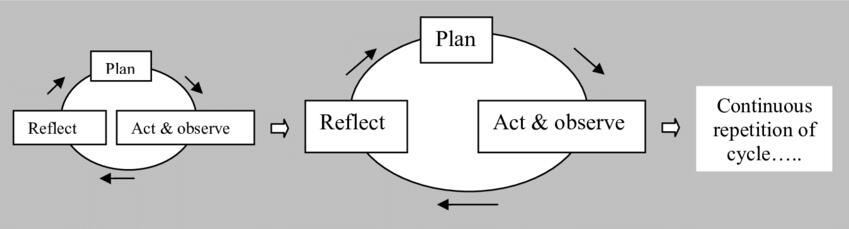
A diagram of the participatory action research cycle. Unfortunately I couldn't think of anything interesting for this.Baral, Himlal. July 2008. "Figure 3-2". From https://www.researchgate.net/. Retrieved October 30, 2023 (https://www.researchgate.net/figure/2-The-participatory-action-research-PAR-cyclefig4272291668).
Participatory action research collaborates with stakeholders to solve issues within their community. It is a conscious effort seeking to study something for the sake of changing or improving it. There are three basic phases: it begins with looking, gathering information, and considering stakeholders and problems. Thinking comes next, involving making interpretations and reflecting on what participants are doing. Finally, during the action phase, you consider what actions would be most effective for positive change, all while working with stakeholders.In the action research spiral process, you identify research question(s), gather information to answer those question(s), analyze and interpret the information, and share results with participants. In the first stage, researchers help stakeholders with recognizing problems important to the stakeholders themselves. The method a researcher uses to gather data is up to them, but it must involve stakeholders as well, whether it be regarding data collection, working as guides or recruiters, or being research assistants. Once data is collected, it must be analyzed with participation of the stakeholders. However, developing accounts can be difficult because you may not gather all participants required to form viable action because of potential conflicting opinions. If there are many stakeholders, it may also be difficult to include all of them through every step of the process at all times. The effort it takes to include all stakeholders thoroughly may be difficult but worth it. Lastly, stakeholders should know the results of the study, which can be through a website, a presentation, a community meeting, etc., because reports can be difficult to read.While action research is incredibly useful, it is not a means for drawing comparisons or simply describing or observing groups. Rather, it places emphasis on information that can be gathered with the help of stakeholders to benefit them by making change, making the researcher a partner rather than an observer.There are three similar categories of types of action research. The technical/scientific/collaborative mode has the primary goal of testing a particular intervention based on a predetermined theoretical framework, wherein the research takes place between the researcher and practitioner. The practitioner is a middleman for the group and the researcher. In the practical/mutual collaborative/deliberate mode, the researcher and practitioner collaborate to identify problems, causes, and possible interventions. Communication starts with the researcher and facilitator who provides input from stakeholders. This is more flexible than the technical/scientific/collaborative mode and is more about emancipating stakeholders who are working with the practitioner, but the goal is still oriented toward understanding practice and solving immediate problems. Because of how these changes are made, interventions leading to change may cease as research does. Finally, emancipating or empowering/enhancing/critical science mode combines theory with the real world and is also meant to assist practitioners in a deeper understanding of the world.Photovoice is also used in action research. A researcher gives participants a camera and asks them to take pictures to allow the researcher to see the world through the lens of participants to empower them, encourage a dialogue and exchange knowledge, and access the perception of those who aren't in charge to bring them to those who are, giving a voice to the voiceless. After photos are taken, they must go through three stages. Participants first need to select what photographs they think are most suited for their concerns, then contextualize them and share their story and thoughts behind them, finishing with coding the images to identify central issues, themes, or theories throughout the previous process.Participatory action research is unique and beneficial in that it has inherent validity checks provided by stakeholders that truly produce results and give power to change to those who otherwise cannot. Despite how valuable stakeholders are, however, they may not be beneficial to you in the way of being researchers, and not all perspectives will be compatible. Findings also may not be generalizable to other contexts, and sadly, your research and compassion may fall on deaf ears.Symbolic interactionism is about the significance of interaction between individuals and what those interactions mean to each other and themselves. In participatory action research, there is much to be gained from the interactions and communication between facilitators, stakeholders, and the wider community.In sociological interaction, participatory action research is inherently about the micro-level activities of facilitators and stakeholders that are intended to change the macro-level social structures that require change brought on by action research.My research specifically has the ultimate goal of being able to change public perception on BPD and hopefully in the future will be able to inform larger social structures such as hospitals and other care facilities to improve acceptance of people with BPD.Berg, Bruce L. and Howard Lune. 2017. Qualitative research methods for the Social Sciences. UK: Pearson Education Limited.
Visual Research Methods
Chapter 5: The Failure of “The President’s Choice”
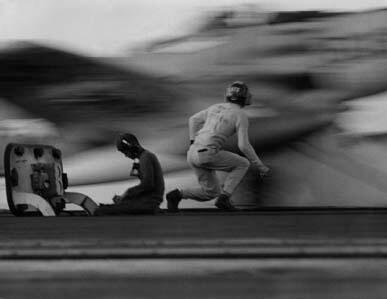
I don't think any images from The President's Choice exist online, so this is just one picture from the book. I thought it was interesting it received a unanimous committee vote but was not, in fact, the President's choice.Cote, Jean and Moeser, Robert. Retrieved October 29th, 2023 (https://methods.sagepub.com/book/visual-research-methods/n5.xml).
In 1965, President Lyndon B. Johnson requested three monthly photographs that "most powerfully portray the problems of America and the efforts to meet them." However, the President's Choice Photography Program suffered from critical flaws. Duganne initially found that the most glaring issue was that selecting images was incredibly subjective and frequently debated by the selection committee, whether pictures should be evaluated based on their ability to communicate through feeling versus formal appeal and self-sufficiency. MoMA curator John Szarkowski's preference for the formalist approach, which focused on the intrinsic qualities of a photograph, led him to categorize pictures in his exhibits based on formalist characteristics. He emphasized a photograph's self-sufficiency but also believed that photojournalism could be appreciated for its aesthetics, albeit after the self-sufficient story had been told in a picture. Meanwhile, the previous MoMA curator Edward Steichen, after his fieldwork in both World Wars and influenced by photographs by members of the Photographic Division of the Farm Security Administration, began to view photography's biggest contribution as having an inherent ability to communicate through feeling—a perspective President Johnson aligned himself more with than formalism. For example, Johnson had selected a photograph by Ken Heyman, recognized for his usage of photography as a form of emotional expression, as the first President's Choice.Duganne, upon doing more research, finds many of the pictures themselves instead of relying solely on text-based materials. Duganne compares and contrasts the photos and the value people found from them, such as one of Heyman's photographs of Peruvian children drinking out of tin cups, overshadowed by the emotional intensity of the framing of a picture of an Ecuadorian child drinking out of a cup. They originally assumed the main issue was the conflicting perceptions and values of photography, when it was more about the selection committee assuming the formal interest of photographs would be universally understood, while Johnson's administration assumed the feelings in their photographs would be. The downfall was ultimately the inability to acknowledge the nuanced dimensions of photographic interpretation, and it is important for us today to bring that nuance back into our lives.The President's Choice is perfectly framed within symbolic interacionism. It was, at its core, about communicating the problems America had at the time and its efforts to quell them. The individual pictures taken by all photographers involved in the project were linked to larger social structures, such as the wide representation of what America was like and what it was doing.This chapter is personally interesting to me because I had never heard of formalism before. Before reading these chapers, the intricacies and nuances of photography in the context of visual methods never came to mind, so it's an insightful angle through which to look at photography.Duganne, Erina. 2007. "The Failure of 'The President's Choice'" Pp. 121-137 in Visual Research Methods, edited by G.C. Stanczak, Thousand Oaks, CA: Sage Publications, Inc.
Chapter 6: Using Photography in Studies of Immigrant Communities
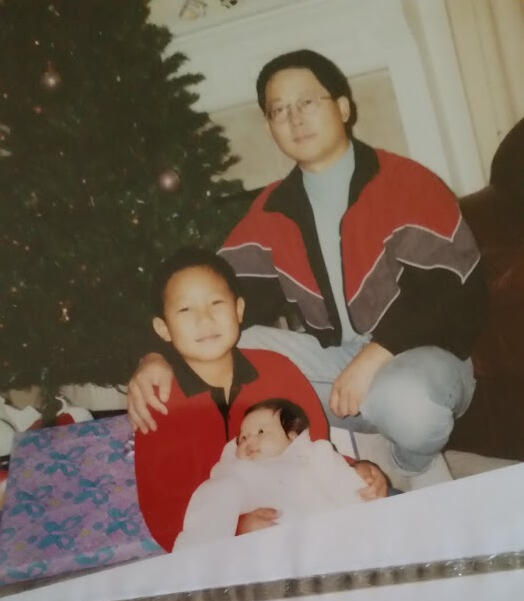
Once again, myself. More specifically, my dad, my brother, and myself the Christmas after I was born. My dad was born in China in the 1960s and immigrated to America in the 90s, during which my brother was born in China, and moved to America with my mom (also born in China) to be with my dad a few years later. Shortly after, I was born and am not actually an immigrant, unlike the rest of my family.Unrelated, this is one of my favorite photos of myself because babies look really funny and I am not remotely conscious of the fact a camera is being pointed at me.Li, Asher. December, 2001. "family". Retrieved October 29th, 2023.
This chapter describes Gold's techniques for using photography in sociological research. Sociologists debate the role of visuals in sociological studies, with some asserting that it should be the central object of study and the focus of investigation, while others claim that pictures are merely dressing. Alternatively, some suggest that photos don't have to be the primary focus of the study but can complement it, establish rapport, contextualize subject matter, and humanize respondents. They can also be used to include students and colleagues and make presentations more accessible. Ethnographic filmmakers present another model for incorporating images into fieldwork projects, using a research and documentary approach to organize images and concepts into a coherent presentation.There are four key uses of photography in immigration research. "Gaining orientation" involves recording information about people, locations, and events during the initial stages of field research to gain a visual context for a more comprehensive understanding. Images can also assist in recording, coding, and analyzing field notes. Taking and sharing photographs can be useful in developing rapport and demonstrating familiarity with the subject and environment of research to improve the quality of subsequent interviews. This can also be used for photo elicitation interviews. With the advent of digital technologies, digital photography and emailing images offer many benefits, providing a quick and cost-effective way of producing and enhancing images. One of its greatest advantages is the ability to extend rapport due to its ease of reach. Finally, visual data can be integrated into the analysis process, such as Becker's "interrogatory principle" suggests about using photographs to answer questions raised by literature reviews and previous fieldwork, analyzing them alongside other data to generate additional questions, repeating the cycle to incorporate additional evidence and produce findings.Gold applied his photography techniques in the context of migrant communities, ethnic economies, and gender in migration processes. In the context of migrant communities, Gold found that Soviet Jews, Vietnamese, and Israelis cooperated among themselves and with other ethnic groups, but subgroups with common themes had more developed forms of cooperation than the entire community. The existence of these subgroups indicated diversity in social orientations and patterns of association. The strongest ties were found within subgroups sharing high levels of social capital, and establishing groupwide alliances was desired but challenging. Regarding coethnic and outgroup labor, Gold found that many migrant groups aimed to help their own by providing jobs and services, but deeper issues, such as economic constraints when hiring individuals of the same ethnicity, came into play. While all three groups found it easier to communicate with coethnics and considered them to be overall better, coethnic workers often demanded more privileges. Latinos, in particular, were frequently used for labor, as outgroup workers were seen as more cost-effective and less likely to compete with employers as future entrepreneurs. When studying gender roles, Gold's evidence challenged blanket generalizations about the gender roles of various nationalities. For example, the Vietnamese La family only communicated through men, while the Dinh household included women and many others who were not part of the household, demonstrating that a shared nationality did not imply shared gendered roles. However, gender arrangements were not random. Vietnamese women were involved in entrepreneurship, while men pursued careers in firms or nonprofits. Israeli women often networked for assistance in domestic activities, developed a social life, and provided Israeli culture and language for their children, skills they drew on to involve themselves in activism. Soviet Jews, both male and female, focused on paid employment and were unfamiliar with communal activism. While photography provided valuable insights, it also posed challenges, such as cultural restrictions on photography during religious events and the potential for misinterpretations of images.Feminist theory urges us to critically examine and deconstruct traditional gender norms and stereotypes, which is what Gold set out to do with gender roles in migrants and found that the diverse approaches to gender roles among different immigrant groups challenge the notion that gender roles are universally prescribed by culture. By doing so, we are able to use our sociological imagination to question our preconceived notions about gender and recognize the impact of broader societal forces on individual behaviors that lead to the establishment of gender roles.My personal connection with this chapter is that my family is part of the immigrant community; my mom is very socially active and communicates with other Chinese families and we take turns hosting potlucks for holidays. I don't really think I have to elaborate on that.Gold, Steven J. 2007. "Using Photography in Studies of Immigrant Communities" Pp. 141-163 in Visual Research Methods, edited by G.C. Stanczak, Thousand Oaks, CA: Sage Publications, Inc.
Blogs
Blog 3
Qualitative Research Methods for the Social Sciences
Chapter 8: Unobstrusive Measures in Research
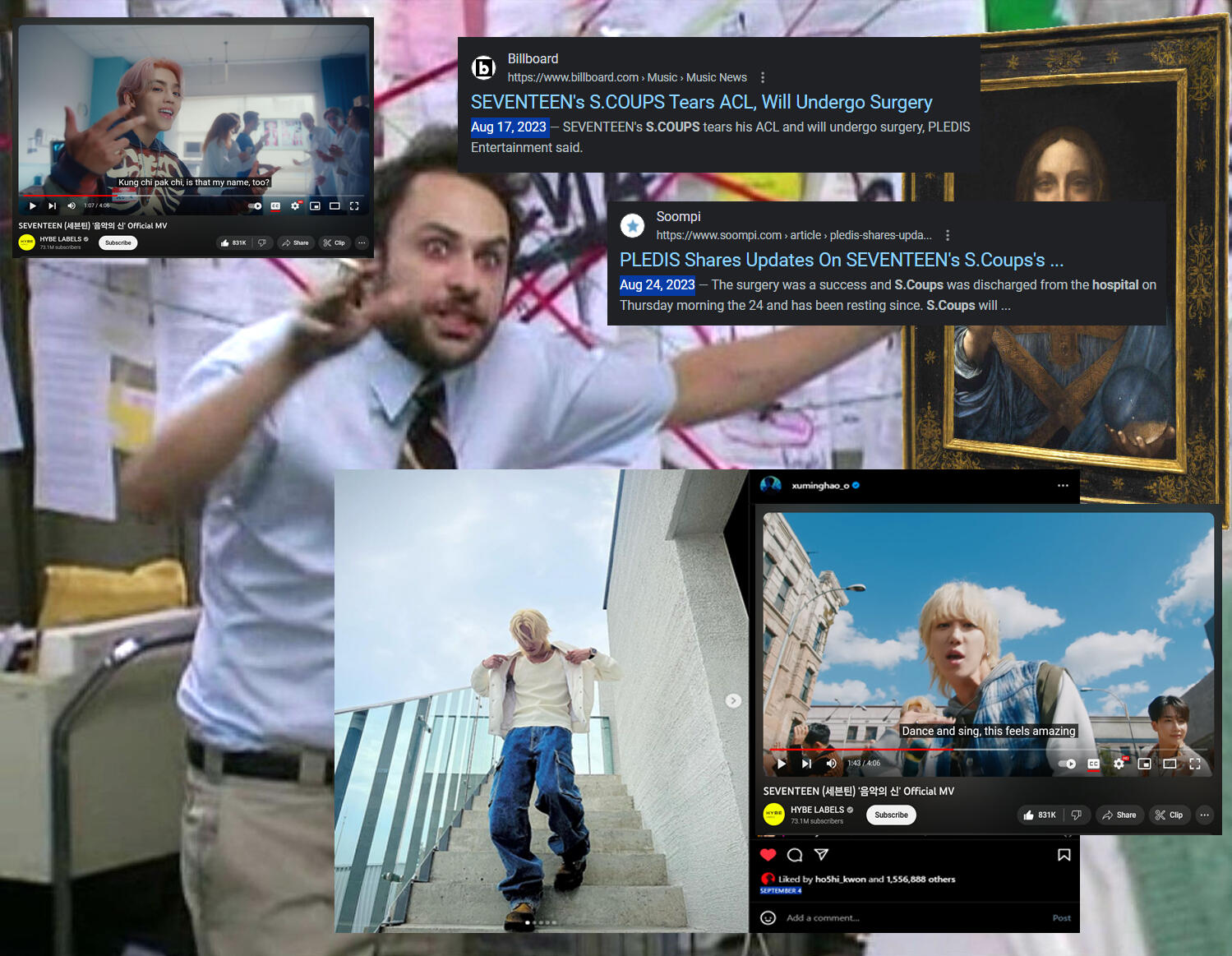
My favorite band recently released a new music video and interestingly, one member was in the hospital for all of the music video, which led me to wonder if the music video was filmed while he was actually in the hospital as he underwent surgery. I cross referenced dates from news articles and Instagram posts from another member to conclude that he was not in the hospital at the time of filming. Naturally, I made a meme of it.If you're curious, it was announced by his agency that SEVENTEEN's S.Coups was hospitalized for a torn ACL on August 17th, 2023 and discharged on the 24th. Fellow member The 8 posted on August 28th pictures of himself with black hair and on September 4th, pictures with blond hair, meaning that he dyed his hair sometime between those two dates, August 28th at the earliest. His hair was blond in the music video in question, which means that at the earliest it was filmed just after The 8 had already dyed his hair which would have been after time S.Coups had already been discharged. However, it is important to note that in the same music video, he is never seen doing strenuous activity. The image was simply not big enough to contain additional information which includes that ACL injury rehabilitation lasts 6 to 9 months and he is seen in more recent videos sitting down, indicating that while he is no longer in the hospital, it can be inferred that he is still undergoing recovery.Li, Asher. November 1st, 2023. "this is what research looks like.png". Retrieved November 1st, 2023.
Unobtrusive data refers to information collected independently of the processes that created them, usually involving social artifacts, traces, or other materials/events created by humans. These traces often provide a more descriptive account of people's lives than they may offer themselves and can be pragmatically used, such as in crime analysis. Unobtrusive data collection is particularly useful for gathering information on subjects that may be challenging or impossible to investigate directly.Two types of archival records can be gathered: public and private. Public archival records, prepared for an audience, are typically standardized and systematically arranged. Commercial media accounts, utilizing visual ethnology like photography and motion pictures, offer insights into society and people. Actuarial records, such as birth and death records, marriages, divorces, and deeds, are produced for limited audiences but can be available to the public for social science research. Despite their utility, these records present challenges, including obscured data, gaps affected by political preference, and potential publication biases.Official documentary records from schools, social agencies, hospitals, etc., contribute written files and communications intended for specific audiences but often made public. While archival data alone may not answer a research question, some studies heavily rely on it. Ethical concerns arise due to the large amount of identifying information in this data, necessitating careful handling. The rise of technology allows for instant production of archives through recordings and videotaping.Private archives, created for smaller or nonexistent audiences, include autobiographies, diaries, letters, home movies, videos, and art. Autobiographies, derided by some, offer artifacts of a writer's perspective on a time and place. A special form is the diary or personal journal, containing personal and unadulterated information. The diary method, assigned to research participants, circumvents memory decay and allows individuals to provide information about themselves and others.Physical traces of human activity can be erosion (selective wear) or accretion (accumulation of traces over time). Unobtrusive data gathering is valuable for accessing information not otherwise available and gaining unique insights into human activity. However, it is susceptible to error and tampering, requiring creativity and informed decision-making.Symbolic interactionism is heavily involved in unobtrusive data gathering due to its inherent intent to gather interactions between the individual and the world they live in and the way they perceive it. The individual can also be involved in larger social structures. For example, a diary entry can describe overarching social phenomena.Unobstrusive data gathering is interesting because it is so easy to acquire, especially with the advent of the internet. The picture is a personal example of my data gathering. I got curious about something, and within only a few minutes of Google searches and investigating I was able to find information that has not been revealed to the public. This also reminds me there was this one time a pastor wandered onto campus and someone found his Whitepages and his full criminal record online, which included at least a dozen instances of contempt of court and no less than three stalking charges/restraining orders.Berg, Bruce L. and Howard Lune. 2017. Qualitative research methods for the Social Sciences. UK: Pearson Education Limited.
Chapter 9: Social Historical Research and Oral Traditions

A screenshot from the still-active website for the UFO cult Heaven's Gate, which came to a close on March 22nd, 1997 as the last of 39 members committed suicide to enter the "Evolutionary Level Above Human" following the Hale-Bopp comet. The website is run by two remaining believers who stayed for the purpose of maintaining their doctrine and hasn't been updated since the mass suicide. The material on the website is written mostly if not all by Do, the cult's last remaining leader by 1997, and includes a wealth of material that provides valuable insight into the practices, beliefs, and thoughts of the cult and Do himself.March 22nd, 1997. From heavensgate.com. Retrieved November 1st, 2023 (https://www.heavensgate.com/).
In academia, history constitutes an interpretive account of past events or a series of events. Historical research serves as a method for uncovering the past, while social historical research aims to understand and explain, reconstructing a comprehensive picture of the when, how, what, and why. This involves utilizing primary sources, which are the original outcomes of an event or experience, secondary sources, which are items not immediately present at the time of the event, and tertiary sources that distill prior sources into a collection.Embarking on historiography starts with an idea or question, followed by seeking basic background information to strengthen concepts, questions, and research strategies. Poring over literature provides an opportunity to refine your concepts.External criticism involves assessing the veracity of source material, which may be compromised by poor translation, censorship, inaccurate memories, counterfeits, or hoaxes. Consideration should be given to the identity of the source's author, the authority of the source, potential bias, intended audience, cross-checking, and historical context. Internal criticism questions accuracy and trustworthiness, considering the author's intention, references, accuracy, and cross-checking. Both external and internal evaluation ensures valid and reliable data, facilitating viable historical analysis. This process sets historical research apart from other archival unobtrusive methods that may not undergo such rigorous scrutiny. Accurate data is essential to ensure robust content analysis.Oral history is provided by narrators who share their stories in their own manner. These oral histories convey narratives that might otherwise go untold due to oppression and provide a voice to the people. While it may not always be feasible to gain access to individuals willing to share their stories, the internet has made it more accessible, necessitating a degree of care to maintain accuracy.Oral histories are a form of symbolic interactionism, communicating a story to be interpreted by the listener. They may also be important because they are the remnants of a larger societal structure that would have otherwise drowned them out.I think oral histories are interesting because I always think about my dad, who grew up in China as they suffered the direct effects of the CCP and will always have an interesting story I've never heard before.Berg, Bruce L. and Howard Lune. 2017. Qualitative research methods for the Social Sciences. UK: Pearson Education Limited.
Visual Research Methods
Chapter 8: When Words Are Not Enough
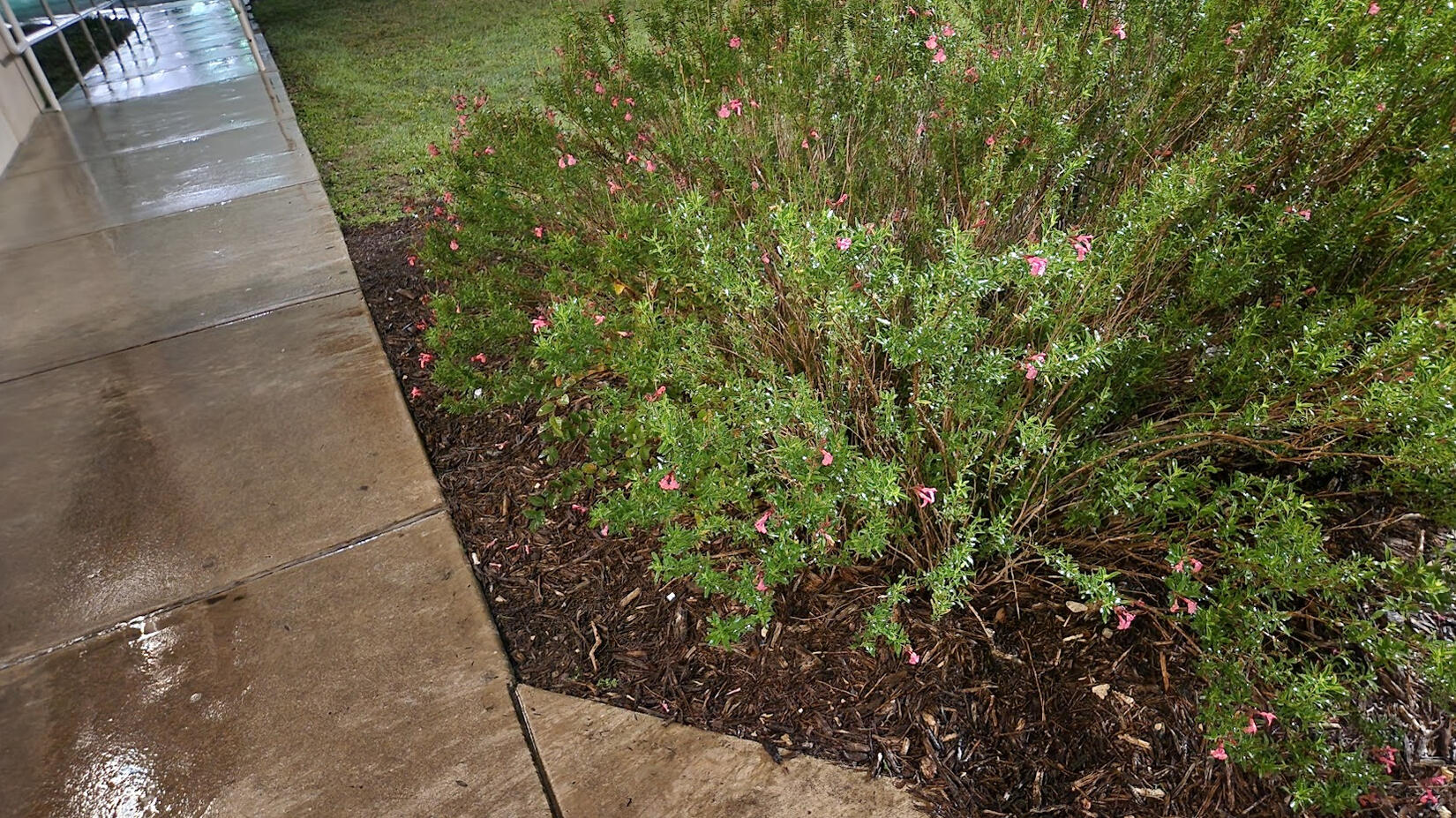
I asked a friend to do photo elicitation and received this photo in return. His explanation was that "it looked nice".
Seo, Myungho. November 2nd, 2023. Retrieved November 2nd, 2023.
Jeffrey Samuels details his experiments with photo elicitation in his study of emotionally satisfying experiences in Buddhism and how young novices are taught to bring about those experiences for Buddhist laypeople. He focuses on autodriven photo elicitation, which he believes better captures the world of the subjects. He interviewed them, had them take their photographs, and explained them after the photos were developed. In doing so, Samuels discusses his experiences with photo elicitation among monastics. He found that photo elicitation allowed him to establish rapport more quickly, enabling discussions of more substantial issues that were overall more encompassing and provided richer data. This form of study also allowed him to reconsider his personal assumptions about monastic life in Sri Lanka. However, he was hindered by time constraints and technological errors with cameras, concluding that as useful as photo elicitation is, it cannot stand alone.
Photography is always a good example of symbolic interactionism and in conjunction with the explanations provided alongside them, effectively communicates the intentions and beliefs behind the photographs monastics provided. These smaller photographs represent a part of a much larger whole of Buddhism.I did photo elicitation and it was interesting.Samuels, Jeffery. 2007. "When Words Are Not Enough" Pp. 197-220 in Visual Research Methods, edited by G.C. Stanczak, Thousand Oaks, CA: Sage Publications, Inc.
Chapter 9: Signs of Resistance
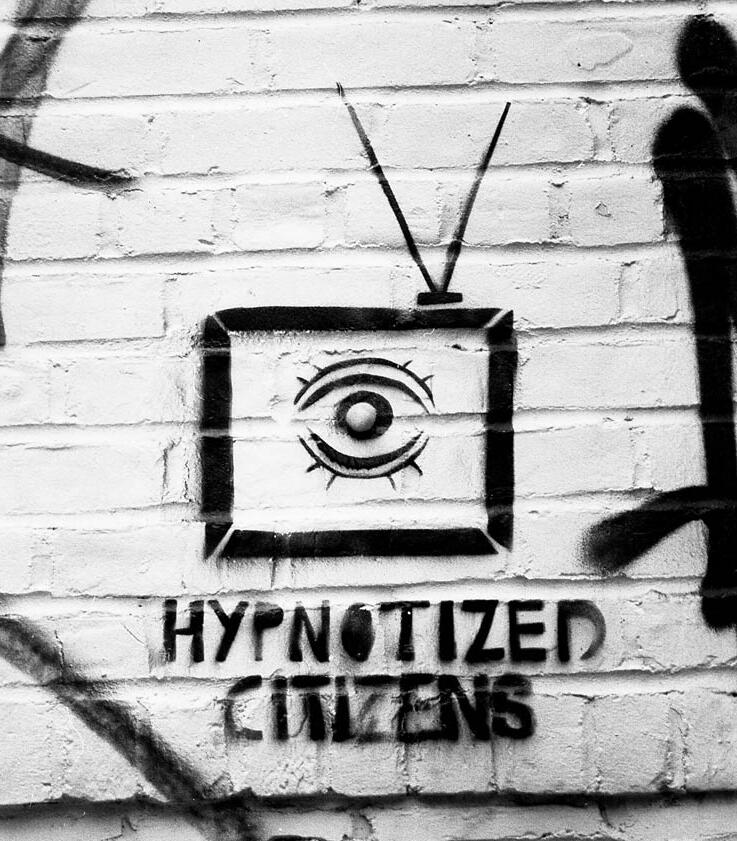
Rojo, Jaime. February 9, 2017. "Visual Resistance". From Brooklyn Street Art. Retrieved November 16th, 2023 (http://www.brooklynstreetart.com/tag/visualresistance/).
David explores signs of resistance through political graffiti and political posters, utilizing photography to capture these expressions and searching for recurring themes. He conceptualizes graffiti not merely as street art but as a form of visual resistance, acknowledging its criminal nature while avoiding romanticization. Drawing on cultural/interactionist criminology, he argues that visual resistance employs stylized symbolism to challenge cultural control, with its creators reclaiming urban spaces by disrupting institutionalization. The examples provided include instances of visual resistance commenting on urban development and buskers, using imagery to delve into societal issues. These visuals extend beyond the immediate street context, offering commentary on regional and national issues, such as the anniversary of the signing of the Louisiana Purchase. URLs play a significant role, transcending geographical limitations and expanding the impact of visual resistance beyond physical spaces.Symbolic interactionism communicates the intent and messages between those who create symbols and visual resistance that speak to larger societal issues. It's an interesting viewpoint I hadn't considered to reframe political graffiti as visual resistance.David, Emmanuel A. 2007. "Signs of Resistance" Pp. 225-251 in Visual Research Methods, edited by G.C. Stanczak, Thousand Oaks, CA: Sage Publications, Inc.
Blogs
Blog 4
Qualitative Research Methods for the Social Sciences
Chapter 11: An Introduction to Content Analysis
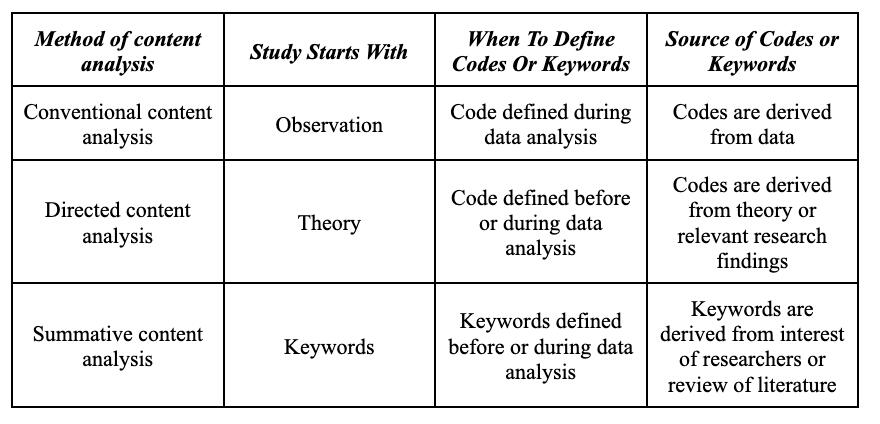
From Delve. Retrieved November 15th, 2023 (https://delvetool.com/blog/what-is-qualitative-summative-content-analysis).
Content analysis is a systematic examination and interpretation of material (social artifacts), identifying patterns, themes, assumptions, and meanings. Coding converts content into data, which is then analyzed. Content analysis encompasses both coding operations and data interpretation, serving as a research technique for making replicable and valid inferences from texts. There are three major approaches: interpretative approaches that treat social action and human activity as text for analysis, social anthropological approaches accomplished by recording information in field notes and applying an interpretative style to treat this information as text, often requiring analysis of multiple data sources that need sorting, and collaborative social research approaches conducted with stakeholders.A standard set of analytic activities involves collecting data and making it legible, developing analytical codes that are then transformed into categorical labels or themes, sorting materials by these categories, examining sorted materials to isolate meaningful patterns and processes, considering them in light of previous research and theories, and making a small set of generalizations. The researcher's task is to establish meaningful procedures for systematic analysis, determining exhaustive selection criteria, deciding what content is being coded, how it is to be coded, and how the codes are used.Communication analysis involves the message, the sender, and the audience. Decisions on levels to sample and the unit of analysis (words, phrases, sentences, paragraphs, etc.) must be made. Content can be found in various forms such as words, themes, characters, paragraphs, items, concepts, and semantics, and may require a combination. Three major procedures are used to identify and develop classes and categories in standard content analysis: common classes of a culture in general, special classes used by members to distinguish, and theoretical classes that emerge in data. For open coding, specific and consistent questions are asked of the data, the data are minutely analyzed, coding is frequently interrupted to write theoretical notes, and traditional variables' analytical relevance is never assumed unless necessary. Analysis is facilitated through coding frames, used to organize data after open coding is completed. In negative hypothesis testing, a rough hypothesis is formed based on an observation from the data, a thorough search of all cases is conducted to locate negative cases, and when found, the hypothesis is either discarded, reformulated, or narrowed to exclude the negative case, and relevant cases are examined.Stages involve starting with the research question, reading through the data, jotting down relevant themes and category labels, establishing objective criteria, sorting data accordingly, and explaining thematic patterns, which can be done with computer programs.Content analysis and symbolic interactionism both involve the interpretation of symbols in materials, revealing patterns, themes, and meanings. In sociological theories like structural functionalism, content analysis serves to unveil the functions of symbols and patterns in contributing to society.Berg, Bruce L. and Howard Lune. 2017. Qualitative research methods for the Social Sciences. UK: Pearson Education Limited.
Chapter 12: Writing Research: Finding Meaning in Data

This image is plagiarized.
Plagiarism is bad, and don’t do it. It happens when you turn in someone else’s work as your own and copying sources without citing. It happens when you run out of time, writing from notes, etc., which can be avoided by citing.In identifying the purpose of writing, ask what are we doing, why are we doing it, and who are we doing it for. Papers can be divided into segments for readability. Title to tell the reader what it’s about, abstract as a brief summary, introduction that orients the reader to the study and paper, literature review that comprehensively reviews previous works, methodology that explains how the study was conducted with subjects, data, setting, and analysis techniques, findings or results, discussions and/or conclusions, and references, notes, and/or appendices. Present finished material through professional meetings and publications and make sure it’s interesting and rewritten to polish. Do not date stamp, refer vaguely, use passive voice, long and run-on sentences, lazy word beginnings, similar word confusions, and rhetorical questions. Ultimately, sometimes stuff just doesn’t work because of improper research and planning, faulty demographics, not enough data, and humans can just lie.Plagiarism is symbolic in that it's a breakdown of the insincerity (intended or otherwise) of the writer and societal norms of honesty. I am currently writing a paper.Berg, Bruce L. and Howard Lune. 2017. Qualitative research methods for the Social Sciences. UK: Pearson Education Limited.
Visual Research Methods
Chapter 10: Performances, Confessions, and Identities
There's this really awful picture I hate of myself at my brother's wedding after getting my first full face of makeup done I contemplated putting here that is a visual representation of who I, a queer person, am forced to perform as in a space where I'm unable to be myself (someone who does not have eyebrows and also not a girl). Accept this hastily drawn picture of that picture instead.Li, Asher. August 7th, 2021. Retrieved November 20th, 2023 (link).
Holliday goes into detail about her experiments with video diaries to explore queer performances of identity by giving video cameras to participants. They are asked to explore identities in relation to the body, taking videos of themselves in different spaces to gauge how much and in what ways behavior changed. She reviews feminist research and links it back to queer methodology and the ever-shifting meanings of the word 'queer.' She observes how heteronormativity keeps queer people in the closet. Finally, she discusses the limitations of her work and her own framing of it.Videography is a good form of symbolic interactionism because it communicates meaning through visuals and explanations participants provide. The need or urge to change who you are in relation to your surroundings speaks to the larger social structures that make queer people struggle to fit into where they are and who they are. This chapter speaks to me personally because I'm very interested in self-presentation in relation to my surroundings.Holliday, Ruth. 2007. "Performances, Confessions, and Identities" Pp. 255-278 in Visual Research Methods, edited by G.C. Stanczak, Thousand Oaks, CA: Sage Publications, Inc.
Chapter 11: The Symbolism of Video

An image provided to me by a participant, wherein a grandfather clock's pendlum represents her feelings, swinging back and forth.Bee. October 14th, 2021. "and so the pendulum swings". Retrieved November 25th, 2023.
This chapter focuses on ethnography and its challenges in usage with migrant mothers in Italy. Hernandez-Albujar talks about the challenges migrant women face by virtue of being women and the strain it puts on being a migrant. She concludes that her initial desire to use video ethnography simply does not accomplish what she wants it to, as the camera was something that could be dangerous for people who were not documented, and ethics in video ethnography had not quite been established yet. Instead, Hernandez-Albujar creates a video called 'Voices' using symbolic representations, metaphors instead of faces. The video later explains in detail what symbols are in it and what they mean. While using this style of video creation, there are still limitations in regards to ethics and that videos are not as easy to include in books or articles.'Voices' is symbolic interactionism at its most obvious form, using more literal symbols in lieu of the meaning communicated through facial expressions and gestures to communicate the plight of migrant mothers in Italy. The issues they face are part of a larger social structure. It is true that migrant mothers struggle; my mother herself had to stay in China with my brother because, in her words, she was his mother and she wanted to bond with him. However, it held her back from joining my dad in America.Hernandez-Albujar, Yolanda. 2007. "The Symbolism of Video" Pp. 281-304 in Visual Research Methods, edited by G.C. Stanczak, Thousand Oaks, CA: Sage Publications, Inc.
Visual Research Methods
gggggggggggggggggggggggggggggggggggggggggggggggggggggggggggggggggggggggggggggggggggggggggggggggggggggggggggggggggggggggggggggggggggggggggg

Last, First. October 14th, 2023. "name of image". From location. Retrieved October 12th, 2023 (link).
summary and analysis
Research
My research focuses on the stigma surrounding Borderline Personality Disorder (BPD) and how it dissuades or restricts people with BPD from recovery.
There is a large body of existing literature that either focuses on or heavily references stigma against BPD, mostly in a clinical setting and perceptions from healthcare professionals. For brevity’s sake, I have chosen to summarize the three I feel were most important in constructing my interview guide.Markham, D. (2003). Attitudes towards patients with a diagnosis of ‘borderline personality disorder’: Social rejection and dangerousness. Journal of Mental Health, 12(6), 595–612. https://doi.org/10.1080/09638230310001627955The main focus of this study is evaluating the diagnosis of BPD and how it affects nursing staff attitudes and perceptions. Markham (2003) asked nurses to complete questionnaires measuring dangerousness, social distance, optimism for change, and ratings of personal experiences for labels of BPD, schizophrenia, and depression. Registered mental health nurses expressed less social rejection towards schizophrenia and rated them to be not as dangerous as those with BPD, while health care assistants made no distinctions. Overall, staff was the least optimistic about BPD diagnoses and had more negative experiences working with those with BPD than other groups. Patient behavior and diagnostic labels have important effects in the responses of society and a label itself can evoke many stereotypes and stigmas, which is the primary focus of the next study.Campbell, K., Clarke, K., Massey, D., & Lakeman, R. (2020). Borderline Personality Disorder: To diagnose or not to diagnose? That is the question. International Journal of Mental Health Nursing, 29(5), 972–981. https://doi.org/10.1111/inm.12737Campbell et al. (2020) discussed the label of Borderline Personality Disorder and how it can elicit negative practitioner responses and acknowledges that while the psychiatric diagnosis stigma will not be resolved soon, it is important to be able to pair a diagnosis with a treatment plan for recovery. A fair portion of this article is dedicated to the stigma and impact on diagnosis in a healthcare setting, explaining that both clinicians and those diagnosed with BPD do not feel there are adequate resources available for them and negative impressions can cause healthcare professionals to prematurely terminate treatment which can cause significant harm. While having a diagnosis of BPD can limit treatment, an accurate diagnosis is still important for ensuring they receive the correct treatment and provide an adequate amount of funding for specialized services.Rüsch, N., Hölzer, A., Hermann, C., Schramm, E., Jacob, G., Bohus, M., Lieb, K., & Corrigan, P. W. (2006). Self-Stigma in women with borderline personality disorder and women with social phobia. Journal of Nervous and Mental Disease, 194(10), 766–773. https://doi.org/10.1097/01.nmd.0000239898.48701.dcThe last article regards self-stigma in those with BPD (with a focus on women and partially for those with social phobia) and how they react to outside stigma, measured in self-report questionnaires. Women with BPD expressed higher self-stigma than those with social phobia. Awareness, agreeance, and internalization of public negative perceptions can cause poor quality of life that persists even following remission. Stereotype awareness, while not significantly correlated with self-esteem and other indices of psychological wellbeing, was correlated with shame-proneness. In turn, this shame can lead to an avoidant coping style which may prevent people from taking the necessary steps such as seeking treatment. In sum, fear of stigma and self-stigma can get in the way of attempting to seek necessary help in those with BPD and other mental illnesses.